

Professional Telephony in 2026: How to Reduce Missed Calls Without Hiring More Staff
Professional Telephony in 2026: How to Reduce Missed Calls Without Hiring More Staff
In 2026, a missed call is no longer just a minor inconvenience. It can mean a patient choosing another practice, a client contacting a competitor, or a prospect who never comes back.
For organizations handling high call volumes, medical practices, law firms, customer service centers, multi site companies, phone management has become a strategic issue. Yet many still believe that the only solution to overload is hiring more staff. That is no longer the case.
Why Calls Are Still Being Missed
In most organizations, missed calls are not caused by a lack of personnel, but by a lack of structured call management.
Common issues include:
- Uneven distribution of calls between team members
- No real time visibility on call activity
- Unanticipated peak periods
- Poor coordination between multiple locations
- Inefficient call routing based on schedules
As a result, teams are overwhelmed at certain times and underutilized at others.
Without the right tools, optimization is impossible.


I am text block. Click edit button to change this text. Lorem ipsum dolor sit amet, consectetur adipiscing elit. Ut elit tellus, luctus nec ullamcorper mattis, pulvinar dapibus leo.
The Business Impact of a Missed Call
A missed call is never neutral.
In healthcare, it may mean a patient booking elsewhere.
In the legal sector, an urgent client may contact another firm.
In a call center environment, it can represent lost revenue.
Over the course of a month, this can amount to dozens or even hundreds of lost opportunities.
Very few organizations actually measure the cost of a missed call. Yet it is a key performance indicator.
What High Performing Organizations Do in 2026
Organizations that have significantly reduced missed calls do not necessarily hire more staff.
They optimize their telephony.
They implement:
- Clear call organization to prevent overload
- Smart distribution of calls across teams
- Seamless coordination between different locations
- Real time visibility to adjust quickly
The difference is not the size of the team, but the quality of management.

Measure to Improve
In 2026, telephony can no longer be managed by intuition.
Key metrics to monitor include:
- Call answer rate
- Average response time
- Call abandonment rate
- Activity by time slot
- Performance by site or department
These indicators allow organizations to adapt staffing, anticipate peak periods, and improve overall service quality.
Telephony as a Growth Lever
For years, business telephony was seen as a technical tool.
Today, it is a direct driver of performance.
Reducing missed calls without hiring more staff is possible.
It requires visibility, structure, and the right technology.
In 2026, the most successful organizations are not those that work more.
They are those that organize better.

Cloud Call Center Software for Indian Businesses
Cloud Call Center Software for Indian Businesses
India is becoming one of the world’s largest hubs for customer support, sales operations and digital services. From startups to large outsourcing companies, more and more businesses depend on high quality phone communication to serve customers in India and abroad. Yet many companies are still using traditional phone systems that are expensive, rigid and difficult to scale.
This is why cloud based call center software is now the preferred solution for modern Indian businesses.

What Is Cloud Call Center Software
A cloud call center is a phone system that runs entirely over the internet. Instead of installing physical PBX equipment, companies use a cloud platform to manage incoming and outgoing calls, route customers, set up IVR menus and monitor agent performance in real time.
This type of system is also known as cloud telephony or virtual phone system. It allows teams to work from anywhere while staying connected to the same professional phone infrastructure.
Why Indian Companies Are Moving to the Cloud ?
Traditional phone systems were designed for offices where all agents worked in the same building. Today, Indian companies operate across multiple cities, use remote teams and need to scale quickly.
Cloud based phone systems make this possible. New agents can be added in minutes, call flows can be changed instantly and companies only pay for what they use. There is no hardware to install and no long term infrastructure to maintain.
For fast growing businesses in India, this flexibility is a major competitive advantage.
Key Benefits of Cloud Based Call Centers
Cloud call center software helps Indian businesses reduce costs while improving customer experience. It eliminates the need for expensive PBX hardware and allows companies to scale their operations without technical constraints.
Managers gain access to real time call statistics, recordings and performance dashboards, making it easier to optimize sales and support teams. Agents can work remotely with the same tools as if they were in a central office.
How Ubicentrex Supports Indian Businesses
Ubicentrex provides a complete cloud based phone system designed for companies that need reliability, scalability and full control over their communications. With Ubicentrex, Indian businesses can manage calls, route customers, track performance and onboard remote agents from a single platform.
The system works without any physical equipment and can be deployed quickly, allowing companies to focus on their customers instead of their infrastructure.
A Modern Phone System for a Digital Economy
As India continues to grow as a global business hub, companies need communication tools that can keep up with their ambition. Cloud based call center software is no longer a luxury, it is the foundation of modern customer engagement.
Ubicentrex helps Indian businesses move to a flexible, scalable and professional phone system built for today’s digital economy.

How to Choose the Best Phone System for Your SME: Complete Checklist
Checklist to Choose the Right Phone System for Your SME
For small and medium sized enterprises, phone communication is far more than a basic tool. It directly impacts productivity, customer satisfaction and internal organization. Choosing the right business phone system is therefore a strategic decision, not a technical detail.
Here is a practical checklist to help SMEs make the right choice.

1. Clearly define your business needs
Before comparing solutions, start with your internal reality.
How many calls do you handle daily?
Do you manage inbound calls, outbound calls or both?
Do you need advanced features such as call queues, intelligent routing or voicemail management?
Are your teams working on site, remotely or in a hybrid model?
A good phone system must adapt to your workflow, not the other way around.
2. Check compatibility with your existing tools
Your phone system should integrate smoothly with your business software. CRM, customer support tools or internal communication platforms must work together.
This avoids duplicate tasks, improves data tracking and gives teams a complete view of customer interactions.

3. Focus on ease of use
A powerful system is useless if your teams struggle to use it.
The interface should be intuitive, easy to configure and quick to learn.
A user friendly phone system increases adoption and reduces training time.

4. Ensure call quality and reliability
Call quality directly reflects your company’s professionalism.
Check the audio quality, even during peak hours or remote usage.
Make sure the provider offers high availability, redundancy and clear guarantees on service uptime.

5. Review essential features
Some features are key for SMEs looking to structure their communications:
Call forwarding and transfers
Call queues and business hours management
Voicemail and notifications
Call statistics and reporting to measure performance
6. Evaluate support and onboarding
Even the best technology requires support.
Choose a provider that offers responsive technical assistance, clear documentation and onboarding support.
This ensures a smooth implementation and quick problem resolution.
7. Understand the total cost
Do not focus only on the subscription price.
Consider setup fees, support costs, scalability and future upgrades.
A flexible pricing model is essential for growing SMEs.
8. Test before committing
A demo or trial period is a major advantage.
It allows you to evaluate usability, performance and feature relevance in real conditions.
Testing helps avoid unpleasant surprises after deployment.
Cloud telephony, an essential lever for improving customer service quality and optimising the organisation of professional structures
Why do professional organisations use cloud telephony to improve customer service and optimise their organisation?
The telephone switchboard has undergone a profound transformation in recent years. While customer expectations are increasing, many organisations still operate with limited or outdated tools.
However, telephone reception remains the first point of contact and contributes directly to a company’s image of professionalism. When calls are lost, when availability varies from day to day, or when teams lack visibility into call flow, the consequences are immediate. Every unanswered request can be a source of frustration for the customer and a missed opportunity for the organisation.

Modern organisations add another layer of complexity.
Between team mobility, remote working, outsourced on-call services and rotating schedules, traditional landlines are no longer sufficient. Managers need to understand what is happening in real time, track calls, ensure continuity of service and distribute the workload efficiently. Without the right tools, management becomes uncertain and customer service deteriorates despite the best efforts of the teams.
Cloud telephony provides the perfect solution to these challenges
It centralises all communications, facilitates call management and adjusts call flows according to needs. Users have instant visibility of their activity, which improves responsiveness and service quality. Dashboards and statistics enable managers to make informed decisions. Technology does not replace humans; it supports them and enables them to work in better conditions.

Adopter une solution de téléphonie cloud n’est plus une simple évolution technique.
Pour les professionnels, cette modernisation représente un véritable levier d’image et d’efficacité. Un accueil structuré rassure les clients et renforce la confiance. Les équipes gagnent du temps, la disponibilité est plus régulière et chaque appel est correctement orienté.
Adopter une solution de téléphonie cloud n’est plus une simple évolution technique. C’est un choix stratégique qui conditionne l’expérience client et la qualité d’organisation interne. Les structures qui franchissent ce cap prennent une avance réelle dans un contexte où la réactivité et la cohérence du service deviennent incontournables.

Understanding Copyright Law: What Call Centres Need to Know
First impressions matter a lot. And one of the first experiences a customer has with a company is often the answering machine or IVR . The music used in these systems plays a crucial role in creating a welcoming and professional atmosphere, but it is essential not to underestimate the importance of respecting copyright laws.
The basics of copyright law
Copyright is an essential component of the protection of intellectual property. They guarantee creators control over their works.
This means that any original creation, whether texts, photos, music, is automatically protected by copyright as soon as it is created. These rights include:
Right of reproduction: This is the right to authorize the reproduction of your musical work, whether in the form of a recording, a physical or digital copy.
Right of distribution: . This is the right to transmit or make music available to the public.
Right of public communication: This is the right to authorize the public communication of the work, whether on radio, television, on the internet, etc.
Right of transmogrification: This is the right to authorize the creation of derivative versions of the musical work, such as remixes, instrumental versions or adaptations into other languages.
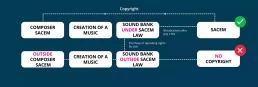
SACEM intervenes abroad either directly by creating a dedicated company, or by concluding a representation agreement with a local society of authors
Copyright infringement can have serious legal consequences. Penalties vary depending on the severity of the violation, but can include substantial fines, damages to be paid to the injured party, or even prison time. It is essential to ensure that you comply with all copyright laws and check the appropriate licenses to avoid any legal issues related to the use of music for your answering machines and music on hold.
The use of music by call centers
When using our business phone software at Ubicentrex to manage answering machines, there may be specific challenges related to the use of music. Choosing the right music is essential to providing an enjoyable experience for your callers, but respecting copyright is just as crucial.
To choose music without infringing copyright, you have several options:
- You can opt for licensed music, which means you have obtained permission from the artist or record label to use it.
- There are also online music libraries where you can purchase tracks with specific usage licenses.
- You can choose royalty-free music, which is usually free provided you follow the terms of use specified by the creator. This music is not subject to any royalties from SACEM and SCPA . If you want to check that music is copyright free, you can consult the catalogs of these same two organizations. It is not obligatory to declare the use of royalty-free music to organizations.
- The fees paid to SACEM cover the rights of the authors responsible for the lyrics and the composers behind the music you use. At the same time, payments to the SCPA are intended to compensate the artists performing these songs as well as the producers who financed the recordings you use. It is important to note that even if you have made a declaration to SACEM for musical use while waiting, this does not exempt you from the obligation to obtain prior authorization from the SCPA.
Public domain
A musical composition enters the public domain as soon as the exclusivity on this work expires, i.e. after a period of 70 years from January 1 of the year following the death of the author. Therefore, it is no longer necessary to pay copyright fees or obtain permission to reproduce or use the work. In other words, it’s perfectly legal to choose Beethoven’s Third Symphony or compositions from before the 1950s as your phone on hold music.
Ubicentrex offers you different music. When music is not copyright free, we notify it.
Please note, if you choose no-royalty free music, it is your responsibility to make the declarations and pay the royalties.